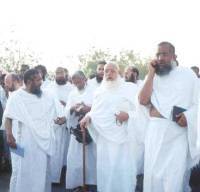
 WILL FOR HAJJ WILL FOR HAJJ
� If Hajj is incumbent upon someone, he should try to perform it as soon as possible. But if he is unable to do so due to a disability, etc., he should, while he is alive, send somebody for Hajj on his behalf. This is called Hajj Badal which will be discussed in detail later.
� Or at least, he should leave a will for his heirs that they should arrange for Hajj on his behalf using money out of his inheritance.
� It may be mentioned that the will is valid for only one third of the estate of the deceased and the rest goes to the heirs who may or may not like to part with their share.
� Therefore, the best course of action is to perform Hajj yourself or send somebody on your behalf if unable to do it yourself. Otherwise, if someone did not perform Hajj or get it performed, or did not leave any will at death, then an imperative duty (Fard) will stay due which is a great sin.
MIQAT (STATIONS OF IHRAM)
Around Makkah, the Holy Prophet has fixed such places that cannot be crossed by people going to Makkah without entering the state of Ihram (The pilgrim�s robe consisting of two seamless sheets, the detail of which will come at its place). These places are called Miqats and are five in number.
1. Zil-Hulaifa: This is the miqat for the residents of Madinah and for those who approach Makkah via that route. It is about 9 kilometers from Madinah and about 250 kilometers from Makkah.
2. Juhfah: This is the miqat for the people who come from Syria or from that direction. This is about 180 kilometers to the west of Makkah.
3. Qarn Al-Manazil: This is a hilly place about 50 kilometers to the east of Makkah, and is the miqat for the people of Najd or for those coming from that side.
4. Zat Irq: This is the miqat for the people of Iran, Iraq and for those coming from that direction. This is about 80 kilometers towards the north-east side of Makkah.
5. Yalamlam: This is a hilly area about 60 kilometers to the south-east of Makkah and is the miqat for the people of Yaman and others coming from that direction. From example, it is the miqat for the pilgrims from India, Pakistan, China, Japan, etc., who come by ship.
PENALTY FOR IGNORING IHRAM
� If someone crosses a miqat without entering into Ihram, he has to offer an animal sacrifice if he is going for Hajj or Umrah. But if he is heading for Makkah for some other reason, Hajj or Umrah becomes imperative (Fard) for him as a penalty.
� If someone has to go to a place other than Makkah, he can pass the points of miqat without entering into Ihram.
UNIQUE MERITS OF THE HARAM OF MAKKAH
The holiest and most blessed structure on the face of the earth is Ka�bah, the House of Allah, and the mosque that surrounds Ka�bah is called Masjid Al-Haram. The reward of one prayer offered in it is worth one hundred thousand prayers offered elsewhere.
The city of Makkah around the Sacred Mosque and the whole territory surrounding Makkah up to several kilometers in every direction has been declared as sacred Haram (sanctuary).
Makkah was the birth place of Prophet Muhammad ( peace be upon him). Although he was forced to move to Madinah, he had profound admiration for Makkah. He is reported to have said:
"O Makkah! Had not my people forced me out from here, I would never have likedto settle elsewhere." (Tirmizi)
Moreover, Makkah is the heart of the world as the Holy Qur�an has called it Umm-ul-Qura (The origin of the cities). (Surah ash-Shura 42:7)
ONLY MUSLIMS CAN ENTER MAKKAH
Non-Muslims are not permitted to enter Makkah although some Europeans are known to have penetrated the sacred city in disguise, the first being Ludovico di Bartema in 1503 and the most famous visitor was Sir Richard Burton in 1853.
PLACES ATTACHED TO MASJID AL-HARAM
1. Ka�bah (Baitullah): This is a somewhat cubic structure, which was built by Prophet Abraham and Ishmael by Divine Command. Since then it has become the source of peace and blessings and guidance for all mankind and the pilgrims circle around it with utmost enthusiasm and devotion. The mosque in which Ka�bah is situated is called Masjid Al-Haram.
2. Different corners of the Ka�bah:
Rukn Yamaani is the south west corner towards the direction of Yaman and is highly sacred. The Holy Prophet
has said:
"The one who touches Rukn Yamaani and Hajar Al-Aswad, has his sins anderrors removed." (Al-Targhib)
3. Rukn Iraqi is the corner towards the direction of Iraq.
4. Rukn Shami is the corner towards the direction of Syria
5. Hajar Al-Aswad: The sacred Black Stone fixed about breast high in the eastern corner of the Ka�bah was originally placed there by Prophet Abraham. Tawaf is started by kissing or touching or pointing towards the Black Stone and brought to completion at it, after seven circui
6. Mataf: This is the wide, open pavement, oval in shape, around Ka�bah and Hatim, where pilgrims perform Tawaf with utmost devotion and enthusiasm day and night except prayer time.
7. Multazam is the wall, five or six feet in length, between Hajar Al-Aswad and the door of the Ka�bah. This is a highly sacred place where prayers are accepted. The pilgrims cling to it pressing their chests and cheeks to it and pray humbly for the forgiveness of their sins and acceptance of their prayers.
8. Hatim is a semi-circular half-built portion at north west which was part of the Ka�bah in the time of Prophet Abraham, but later could not be included in the main structure when Quresh rebuilt it after its destruction by fire. To offer prayer in Hatim is just like praying inside the Ka�bah. The Tawaf around the Ka�bah covers Hatim as well.
9. Mizab Al-Rehmat: The spot under the drain of the Ka�bah�s roof is called Mizab Al- Rehmat and is a place for acceptance of prayers.
10. Maqam Ibrahim (Station of Abraham): To the north-east of the Ka�bah, a little away from its door, stands a glass and metal structure which contains a sacred stone bearing the impressions of the foot-marks of Prophet Abraham who stood here during the construction of the Ka�bah.
This is one of the sacred places where prayers are accepted. After completing the Tawaf, the pilgrims offer two rak�ahs of prayers near it. If it is not possible to pray here, one can do so anywhere in Masjid Al-Haram.
11. Zamzam is the historical well located to the east of the Ka�bah, which was provided by Allah for the sustenance of Prophet Ishmael and his mother in the wilderness of Makkah. Zamzam water possesses great merits and benefits, and the pilgrims have been urged to drink Zamzam water to fill, because it is food for the hungry and cure for the sick.
12. Safa and Marwah: Safa is a hill to the south of the Ka�bah, which has now been leveled down and remains only as a symbol. Opposite to it, to the north of the Ka�bah, there is the hill of Marwah. Performing Sa�ey between these two spots is an important Hajj and Umrah rite.
IMPORTANT HAJJ PLACES WHERE HAJJ RITES ARE PERFORMED
(These places have nothing to do with Umrah. They are described for somebody interested to visit them although spending time in Masjid Al-Haram is more rewarding)
Besides Ka�bah (Baitullah), there are other places of Hajj near Makkah where hundreds of thousands of Muslim pilgrims come every year and they are: Mina, Arafat and Muzdalifah.
PLACES AWAY FROM MASJID AL-HARAM
1. Mina: This is a plain within the bounds of the Haram of Makkah about five kilometers outside the city. The pilgrims pass the night between the 8th and 9th Zil-Hajj here and then proceed to Arafat after sunrise on the 9th of Zil-Hajj. They are back here on the 10th of Zil-Hajj for the three final days of Hajj. Animal sacrifice is offered here.
Jamrahs: The pilgrims throw pebbles on three Jamrahs (stone pillars) representing devils for three days. These pillars are known as Jamrah Al-Ula (small devil), Jamrah Al-Wusta (middle devil) and Jamrah Al-Aqabah (big devil).
Khaif Mosque is situated in Mina where pilgrims offer their prayers during their stay here.
2. Arafat: This is a vast plain about 15 kilometers to the east of Makkah, its bounds start from the place where the limits of Haram end. Arrival in the Plain of Arafat on the 9th of Zil-Hajj and Wuquf (halting) herein until sunset is the foremost Hajj rite without which Hajj cannot be valid. If halting in Arafat is not possible until sunset, then staying there for some time is sufficient to make the Hajj valid. At sunset the pilgrims leave for Muzdalifa without offering Maghrib prayers.
Namirah Mosque is situated right on the meeting place of the boundaries of Haram and Arafat. Here the Imam leads the Zuhar and Asr prayers combined and shortened at Zuhar time.
Jabal Rahmah is a sacred hill in the middle of the Plain of Arafat. Riding his she camel near it, the Holy Prophet (may peace be upon him) delivered his famous sermon on the occasion of the Farewell Hajj.
3. Muzdalifah: This is a place midway on the route from Mina to Arafat. Pilgrims gather here on the night of the 9th Zil-Hajj on their return from Arafat. Here they offer Maghrib and Isha prayers combined. It is obligatory to halt here after Fajr prayer between the break of dawn and sunrise before proceeding to Mina.
Mash�ar Al-Haram: This is an elevated place in the plain of Muzdalifah, which is enclosed by a boundary. At this place, the Holy Prophet (peace be upon him) had prayed to Allah. The Qur�an says:
"When you return from Arafat, stay at Mash�ar Al-Haram and remember Allah; and remember Him just as He has enjoined you." (Al-Baqrah : 198)
Muhassar: This is a valley between Muzdalifah and Mina, where Abraha and his troops along with the elephants, who came to destroy the Ka�bah, were themselves destroyed by the birds (swallows) which threw small pebbles at them from their beaks and claws. As mentioned earlier, this incident happened in 570 or 571 AD. The pilgrims pass this place quickly because Muhassar is a tormented area.
HISTORICAL PLACES OF MAKKAH
Given below are some important places in Makkah which, though not connected with Hajj rites in any way, are worth visiting due to their significance in the early history of Islam. But your travel schedule should be such that you can offer all your prayers in Masjid Al-Haram with jam�at. To be present in the House of God is undoubtedly better than sightseeing.
1. Birth Place of the Holy Prophet: The house where the Holy prophet was born is situated in Suq Al-Lail Street. At this place, there exists a library and a school today. If you come out of Haram near Safa hill, this house is about two furlongs away on the right side.
2. House of Hazrat Khudija Al-Kubra: This house is situated in Fatima az-Zahra Street and is the birth place of all the children of the Holy prophet from Hazrat Khudija. After his marriage, he stayed here until his migration to Madinah.
3. Al-Mu�alla: This is a famous graveyard of Makkah where the Holy Prophet�s mother, Hazrat Khadija, his wife and many other companions were buried. This graveyard is on Ghaza Street near Masjid Jinn.
4. Masjid Jinn: This mosque is near the graveyard of Al-Mu�alla. This is also known as Masjid Bai�et. Here the Holy Prophet recited the Qur�an to the Jinns and took bai�et (oath of allegiance) from them.
5. Masjid Al-Ra�et: This mosque is near Masjid Jinn on the right side. In Arabic ra�et means flag. This is the place where the Holy Prophet installed his flag at the time of the Conquest of Makkah.
6. Cave Hira: Cave Hira is situated on Jabl Noor about three miles from Makkah. The Holy Prophet used to retire here in solitude and spend long hours in reflection and meditation. Here he received his first Divine Revelation:
"Read in the name of your Lord who created, Who created man out of a clot of congealed blood. Read, and your Lord is most Bountiful, Who taught (man) the use of pen, Taught man what he knew not." (Surah Al-Alaq 46 : 1-5)
7. Cave Thaur: This is a cave in Jabl Thaur about eight kilometers to the south of Makkah, in which the Holy Prophet and Hazrat Abu Bakr lay hidden for three days at the time of their migration to Madinah.
8. Jabl Abu Qubais: This is a hill near Safa , right in front of Baitullah. This hill is said to be associated with the Holy Prophet�s miracle of splitting the moon asunder. Bilal mosque is situated atop this hill.
9. Masjid Aai�sha: This mosque is outside the bounds of Haram in Tan�eem, situated on Madinah Road. People enter into Ihram here for Umrah, that is why it is also known as Masjid Umrah. To go there, buses are always available in front of Bab Abdul Aziz of Al-Haram. If you intend to perform Umrah, get a ride to this mosque, enter into Ihram and come back to Makkah to perform Umrah.
1. If you plan to go to Makkah first for Umrah
Enter into Ihram at your residence or at the airport before boarding the airplane and it will sure fly over whatever miqat (station of Ihram) falls on the way. It is allowed to do so before miqat but not after that point. This is advisable because the crew members don�t announce when miqat comes. You may enter into Ihram inside the plane when it is flying high up in the sky but it is not convenient to change your clothes and put on Ihram sheets and there is no
2. proper place to offer prayers. By the way, these instructions are for independent pilgrims. If you travel with a group, follow the instructions given by the group leader. The main thing is that you should be in the state of Ihram at or before miqat.
3. If you want to visit Madinah before Umrah
Some people will like to visit Madinah first before going to Makkah for Umrah. This is more convenient than the first choice because you are not involved with Ihram or the restrictions that go with it. Ihram is not required for the visitation of the Prophet (PBUH)�s mosque or his sacred tomb. Then, when you are ready for Umrah, you go to Masjid Meeqat in Madinah, enter into Ihram and proceed to Makkah.
4. Umrah alone or along with Hajj?
Umrah is performed alone or as part of Hajj Al-Qiran or Hajj Al-Tamatt�u. For those people who do not take sacrificial animals with them, Hajj Al-Tamatt�u is preferable which is performed by almost all people who travel to Makkah from outside. In Hajj Al-Tamatt�u, first you perform Umrah, then come out of Ihram and when the Hajj time comes, you enter into Ihram again in Makkah.
5. Procedure to Enter into Ihram
So, the Ihram you are entering into now is for Umrah only.
Preparation: You should have your hair cut (if needed), unnecessary body hair removed, mustache trimmed and nails pared. Then take a bath with the intention of Ihram or do vudu (ablutions) if bath is not possible.
Ihram: After this, put on two seamless garments of Ihram preferably of white color.
Two Nafls: If it is not zawaal, offer two rak�ahs of nafil prayers by covering your head.
Intention (Niyyah): Now remove the head cover and make the intention to perform Umrah by saying:
o Labbayka Umrah, or
o O Allah, I intend to perform Umrah to please you, so accept it from me and make it easy for me.
You may make intention of Umrah in your own language.
Talbiyah: After the intention, recite Talbiyah three times. Pronouncing Talbiyah once is imperative (Fard) and pronouncing it more than once is Sunnah.
The following are the words of Talbiyah which you should memorize before leaving for this sacred journey because you have to pronounce them frequently:
TALBIYAH
"Labbayk, AllahummaLabbayk.Labbayk. La shareeka laka.Labbayk.InnAl-hamda wan-n�imata lakawAl-mulk.La shareeka lak." (Here we come, O Allah, here we come!Here we come. No partner have You.Here we come! Praise indeed, andblessings, are Yours---the Kingdom too!No partner have You!)
As soon as Talbiyah is pronounced, you are entered into the state of Ihram and all the obligations of Ihram start which are the same in Umrah or Hajj.
One should continue reciting Talbiyah in a loud voice and it should be pronounced thrice each time. Women have to recite Talbiyah in subdued voice if men other than her immediate relatives are around.
Prohibitions of Ihram
All pilgrims, in the state of Ihram, are forbidden to cover their heads (for men), hunt, argue, cut their hair or nails, kill flies, mosquitoes and lice, use perfume, or engage in sexual relations. A woman may wear any dress for Ihram as long as it does not show her adornments, or cause temptation to men. She is forbidden to wear gloves, apply mehndi or to cover her face, but if male strangers are around her, she should conceal her face with her head-covering or something similar making sure it does not touch her face.
What is Umrah? Umrah is a mini Hajj that can be performed at any time of the year. It can be performed along with Hajj and in other days as well. According to Quran:
"---accomplish Hajj and Umrah to please Allah". (Al-Baqrah, 196)
Great Merits of Performing Umrah
The Holy Prophet (peace be upon him) has described the great merits of performing Umrah.
He has said:
"The people who come to perform Hajj or Umrah are the guests of Allah because they visit His House on His Call; therefore, Allah grants them what they ask for".1
He has also said:
"One Umrah becomes an atonement for the sins committed up to the next Umrah".2
He has said again:
"Anyone who leaves his house with the intention of performing Hajj or Umrah and dies on the way will enter paradise without judgement. Allah is proud of those who perform tawaf of Baitullah".3
Umrah in Ramadan
Performing Umrah during Ramadan is most commendable and equal to Hajj in merit and excellence.4
Clarification: It is quite true that an Umrah in Ramadan equals a Hajj and one can get the same rewards that are granted to one who performs a Hajj. But this act does not substitute the performance of Hajj which is Fard (imperative), once in a life time if one is financially and physically capable.
RULES FOR UMRAH
1. Umrah is Sunnat Mu�akidah: Umrah is neither imperative (Fard) nor obligatory (wajib), but performing Umrah once in a life time is Sunnat Mu�akidah. However, once or more than once, whenever it is performed, it fetches great rewards.
2. No Fixed Time: There is no fixed month, day or time for Umrah as it is for Hajj. As said earlier, it can be performed any time one desires.
3. The Miqat for Umarh: The station of Ihram (Miqat) for Umrah is Hill for the residents of the Haram of Makkah and the people of Hill. As mentioned later, the area between the five appointed Miqats of Hajj and the bounds of the Haram of Makkah is called Hill. The Afaqis (outsiders) who come to Makkah for Hajj and Umrah should already be in Ihram before entering into Makkah. However, for subsequent Umrahs, even they have to go to Hill to put on Ihram. For this purpose, buses outside Bab Abdul Aziz of Al-Haram take pilgrims to Masjid Aai�sha which is in Hill on Madinah Road at Tan�eem, not far from Makkah.
4. The Rites of Umrah: The only rites of Umrah are:
o Entering the state of Ihram
o Tawaf of Ka�bah
o Sa�yee between the hills of Safa and Marwah
o Shaving and clipping of the hair
In Umrah, pilgrims do not go to Mina, Arafat and Muzdalifa or throw pebbles on the Jamrahs (stone pillars representing devils) or offer animal sacrifice. These rites are performed during Hajj.
1. Albzar 2. Bukhari, Muslim 3 Albehiqi 4.Abu Da�ud, Bukhari
HAJJ BADAL
Hajj Badal means getting Hajj performed on one�s own behalf and expense by another person, provided that Hajj is incumbent and one cannot perform Hajj due to illness or some other disability.
CONDITIONS FOR THE DISABLED PERSON
1. Hajj should be incumbent upon the disabled person under the Shari�ah rules. If not, there is no need for sending somebody for Hajj Badal and if he later becomes incumbent he needs Hajj Badal performed again.
2. The disabled person should be unfit to perform Hajj himself. If the disability is temporary, he has to perform Hajj himself when he is fit even if he has got Hajj Badal performed earlier. But in case of permanent disability, such as weakness due to old age or blindness, Hajj Badal is enough even if this disability does not exist anymore.
3. The disability should be before sending somebody for Hajj Badal otherwise it will not be valid.
4. The disabled person himself should ask someone to perform Hajj Badal on his behalf. Leaving a will before death is the same as asking somebody. However, it is okay if a heir performs Hajj Badal or gets it performed for a deceased person.
5. The disabled person should bear all types of expenses concerning Hajj Badal.
CONDITIONS FOR THE PERSON PERFORMING HAJJ BADAL
1. The person appointed to perform Hajj Badal must be a Muslim.
2. He should be sensible and sane even though immature.
3. While entering into Ihram, he should make ni�yah (intention) on behalf of the person who is sending him for Hajj Badal.
4. A woman can also perform Hajj Badal on behalf of another woman or man. Traveling with a mahram male is not a condition for Hajj Badal which is valid even without mahram, but she will be a sinner.
5. Hajj Badal should be performed by the appointed person only unless he has been authorized to get it done by another person. In that case, it is okay to send somebody else on his behalf.
6. The appointed person should perform the kind of Hajj, such as Tamatt�u or Qiran, according to the desire of the person who sent him.
7. He should put on Ihram only on behalf of the person sending him. He is not allowed to have the intention of performing Hajj for himself or on behalf of two persons.
8. The appointed person should go for Hajj Badal by conveyance and not on foot.
9. He should start his Hajj journey from the place where the person sending him lives. However, if the Hajj Badal is being arranged out of one-third of the deceased�s property, it can be started from anywhere depending on the money available.
10. He should not miss the Hajj or any imperative (Fard) part of it as no type of compensation renders Hajj Badal validly performed.
11. According to the Hanafites, it is not necessary that Hajj Badal should be performed by a person who has performed his own Hajj first. But as per Ahl Al-Hadith, the appointed person must have performed his own Hajj first. Considering these views, it is safer to send somebody who has already performed his own Hajj.
Note: For more information or clarification on these conditions or if some other question comes in mind, it is advised to consult a religious scholar.
HOW TO PERFORM UMRAH
IHRAM FOR UMRAH AND ENTERING MASJID AL-HARAM
1. Ihram: You should be already in Ihram for Umrah before entering Makkah or as mentioned earlier, enter the state of Ihram at Masjid Ai�sha in Hill if it is your subsequent Umrah or if you are the resident of the Haram of Makkah or of Hill. If you are entering into Ihram now, the next step is to cover your head and offer two rak�ahs of nafl. Then uncover your head, intend to perform Umrah and proclaim Talbiyah three times and as often afterwards as possible. This stars all the restrictions of Ihram which are listed in the description of Hajj. You may review the complete procedure to enter into Ihram discussed earlier.
2. Entering Masjid Al-Haram: While reciting Talbiyah, enter Masjid Al-Haram preferably through Bab
as-Salam with right foot first. Supplicate to Allah and proceed towards Ka�bah. You may recite the following supplication which is usually used before entering a mosque:Allah huma aftah li abwabe rahmate ka
3. First Sight: At the first sight of Ka�bah, keep your eyes fixed at Baitullah and standing at one side, it is suggested that you do the following:
� Say Allahu Akbar three times
� Say La Ilaha Illallah three times
� Proclaim Darud on our beloved Prophet (peace be upon him) and very humbly and with tears in your eyes supplicate to Allah for whatever you wish. This is a special time for the acceptance of prayers.
The idea is to praise and glorify your Creator before proclaiming Darud and supplications. Therefore, in lieu of Allahu Akbar and La Ilaha Illallah, you may recite some other similar holy verses if you so desire.
After this, while uttering Talbiyah, move forward to perform Tawaf of Ka�bah.
TAWAF OF UMRAH
Tawaf means circling around something . Here it means moving around Ka�bah seven times with extreme love and devotion.
1. Preparation: Pass the upper sheet of Ihram from underneath the right arm and put it on the left shoulder. This act bares the right shoulder and is known as Iztaba. Ablutions (vudu) is essential for tawaf. Reciting of Talbiyah is stopped when you reach Hajar Al- Aswad, the starting point of tawaf.
2. Niyyah (Intention): Stand in front of Ka�bah facing Hajar Al-Aswad (the Black Stone) in such a way that the whole Hajre Al-Aswad is on your right side. To achieve this end, you may get help from the black stripe on the floor. This stripe should be on your right side. Then without raising your hands make Niyyah (intention) for Umrah:
"O Allah, I perform Tawaf of Umrah to please You. Make it easy for me and accept it from me."
3. Istilam: Now moving towards right, come in front of Hajar Al-Aswad and kiss it if possible, or touch it with a stick and kiss the stick; if that also is not possible, raise your hands to your ears keeping your open
palms towards Hajre Al-Aswad and say:" Bismillahi Allahu Akbar Wa Lilla Hil Hamd"and drop your hands down. Now point the palms of your hands again towards Hajar Al- Aswad and kiss them. This act of kissing Hajar Al-Aswad or pointing towards it is called Istilam.
4. Tawaf Starts: After Istilam, turn right and start tawaf counter clockwise.
WARNING
� The authorities often apply perfume to Hajar Al-Aswad, Rukn Yamani and Multazam. If so, do not touch them while in the state of Ihram, otherwise a dum will be required as a penalty.
� During tawaf, it is not permissible to face or turn your back towards Ka�bah except when you are kissing or pointing towards Hajar Al-Aswad.
5. Ramal: For the first three circuits of Tawaf of Umrah and Tawaf of Arrival, men are required to move their shoulders and walk with quick short steps. This act is called Ramal and is Sunnah. They walk normally during the remaining four circuits.
6. Supplications of Tawaf: There are no fixed supplications for tawaf but there are several recommended supplications listed in the books of Hajj and Umrah out of which the following supplication is easy to memorize:
"Subhan-Allah wAl-hamdu-lillahi wa la ilaha ill-Allah wa-Allahu Akbar wa la haula wa la quwwata illa-billah."
If you don�t remember these words, you may glorify Allah by repeatedly uttering:
Subhan Allah, Al-Hamdu lilla, Allahu Akbar, La Ilaha Illallah, etc.
The Prophet of Islam (peace be upon him) has said that there are two kalimahs that are light on tongue and (on the day of judgment) they weigh heavy on the scale (Mizan) and are liked by Allah. These kalimahs are:
Subhan Allah Wabe Hamde hi Subhan Allah Hil Azeem (Bukhari, Muslim, Tirmizi)
You may also use supplications used in the daily Salah or you may seek forgiveness of Allah and ask Him whatever you wish in your own language.
7. Hatim: Hatim is a semi-circular half-built portion which was originally a part of the Ka�bah but which could not be included in the main structure when the Ka�bah was rebuilt. It is obligatory to go around Hatim also while performing tawaf.
8. Rukn Yamani and its Supplications: After passing the three corners of the Ka�bah you reach the fourth corner known as Rukn Yamani. Touch it with both hands or with right hand. There is a beautiful supplication to be used while walking between Rukn Yamani and Hajar Al-Aswad:
"Rabbana atina fid-dunya hasanatan wa fil-akhirati hasanatan wa qina azabin-nar."
Our beloved Prophet (peace be upon him) has repeatedly recited this supplication. The first circuit is complete when you reach Hajar Al-Aswad.
9. Seven Circuits: At Hajar Al-Aswad, start the second circuit by kissing it or pointing towards it as you started the first circuit, i.e., come in front of Hajar Al-Aswad, raise both hands to your ears with open palms towards it and say:
" Bismillahi Allahu Akbar Wa Lillah Hil Hamd
Now kiss both palms and drop your hands. After this go around Ka�bah as you did before and similarly complete the seven circuits.
10. The End of Tawaf: At the end of seven circuits, do Istilam of Hajar Al- Aswad or point towards it eighth time which is Sunnat Mu�akidah. Also say:
"Bismillahi Allahu Akbar Wa Lillah Hill Hamd"
11. Iztaba Finished : Now Iztaba is finished, therefore, you cover your both shoulders with upper portion of the Ihram sheet. This does not apply to women.
12. Multazam: Now, come to Multazam which is a place five or six feet in length between Hajar Al-Aswad and the door of Ka�bah. This is a highly sacred place where prayers are accepted. Among a large crowd of people, if it is possible to reach Multazam, cling to it pressing your chest and cheeks, and while trembling and crying with devotion and with all humility seek Allah�s mercy, His blessings and ask Him whatever you wish. If you are unable to come close to Multazam, just face towards it and supplicate from a istance.
13. Maqam Ibrahim: Next offer two rakahs of nafls behind and close to Maqam Ibrahim without covering
your head. If it is zawal time when sajdah is not allowed, you have to wait till this undesirable time is passed and then offer prayers.In the niyyah (intention), say that you are offering 2 rakahs of nafls wajib Al- tawaf. Recite Qul ya ayya hal kafroon in the first rakah and Qulhu wallah in the second rakah. After this, supplicate to Allah in Arabic or in your own language. Ask Him whatever you wish and invoke His blessings.If it is not possible to offer this obligatory prayer near Maqam Ibrahim, it can be offered anywhere in Mataf, or in Hatim or anywhere in Masjid Al-Haram or even at any place in Haram of Makkah.
14. Zamzam: Now go to Zamzam well situated in the basement of the Haram about 200 feet from the Ka�bah�s door. There are separate portions for men and women. Zamzam is the best available water in the world. Drink this water to fill while in standing position saying Bismillah. Then supplicate to Allah:
"Allahummah inni as�aluka ilm-an naafi�an wa rizqan waasi�an wa shifa�am min kulli daa�in."
(O Allah! I implore Thee for beneficial knowledge, for vast provisions, and for cure from every disease.)
RULES FOR TAWAF OF UMRAH
1. One should be in the state of Ihram before starting Tawaf.
2. There are three conditions essential for Tawaf of Umrah and for all other kinds of Tawaf as well, namely:
a. To be a Muslim
b. Niyyah (intention)
c. To perform Tawaf inside Masjid Al-Haram
Without niyyah, Tawaf is not valid. Tawaf can be performed in Mataf or on different floors of Masjid Al-Haram or even on its roof.
3. While performing Tawaf, one should not look towards Ka�bah. One has to face Ka�bah only when doing Istilam of Hajar Al-Aswad.
4. After completing the seven circuits of Tawaf, if someone deliberately starts the eighth circuit, it becomes obligatory (wajib) for him to complete the second Tawaf by doing six more circuits.
5. Undesirable times for prayer are not considered undesirable for performing Tawaf.
6. If someone has to discontinue Tawaf because of time for prescribed prayer or because a dead body is brought for a funeral prayer or need for fresh ablutions arises, he can later resume Tawaf at the point where he discontinued.
A CHEKLIST FOR OBLIGATORY (WAJIB) PARTS OF TAWAF
Tawaf is finished but here is a checklist to make sure that no obligatory part is missed.
1. One should be free from the state of impurity and must have performed vudu (ablutions). The women are not allowed to perform Tawaf during their monthly period and during the impure state after childbirth.
2. One should be properly dressed. The Holy Prophet (peace be upon him) has said:
"Nobody should go around the Ka�bah in a naked state." (Bukhari)
3. To perform Tawaf on foot, performing Tawaf while riding is permissible only when one is unable to do so on foot.
4. To start Tawaf from one�s right side in the counter clockwise direction.
5. To complete seven circuits of Tawaf.
6. During Tawaf, to pass Hatim as well which is in fact a part of the Ka�bah.
7. To start Tawaf from Hajar Al-Aswad.
8. To offer two rakahs of nafls after each Tawaf. It is undesirable (Makrooh) to combine two Tawafs together and not to offer two rakahs of nafls in between.
9. As Tawaf of Umrah is performed while in the state of Ihram, one has to observe all the prohibitions associated with this state.
SA�EY
The literal meaning of Sa�ey is to run or to make effort, but as a Hajj and Umrah term, Sa�ey denotes
walking back and forth seven times between the hills of Safa and Marwah which are situated to the south and north of the Ka�bah respectively. Now there are only signs of these hills and the whole route between them is enclosed in a long gallery.Sa�ey has a historical background. Prophet Abraham left his wife Hazrat Hajra and infant son Hazrat Ismael in the wilderness of Makkah at the command of Allah. The mother and son lived for five days on the food and water they had when the water was completely finished. The mother ran frantically seven times between the hills of Safa and Marwah in search of water for her son. Suddenly the fountain of Zamzam oozed miraculously near the feet of Hazrat Ismael. Sa�ey is included in the rites of Hajj and Umrah to commemorate this event of search and struggle.
RULES FOR SA'EY
1. Sa�ey is obligatory (wajib) after the conclusion of the Tawaf and not before it.
2. To be free from impurity is not obligatory (wajib) for Sa�ey, therefore, women during their monthly period can perform Sa�ey although they are not allowed to enter Masjid Al-Haram, offer Salat or perform Tawaf. They can enter the place of Sa�ey from the outside entrance.
But it is a Sunnah to be free from all types of impurity and be in the state of ablutions during Sa�ey.
3. Sa�ey has seven trips and all are obligatory (wajib). But according to Maulana Khalil-ur-Rahman of Pakistan, the four trips are Fard and the remaining three are obligatory (wajib). Just remember all seven trips have to be completed.
4. It is a Sunnah to start Sa�ey right after Tawaf but it is not obligatory (wajib). Therefore, if Sa�ey is delayed for some reason, there is no penalty.
5. It is obligatory (wajib) to start Sa�ey from the hill of Safa and end at Marwah.
6. It is obligatory to perform Sa�ey on foot unless somebody has an excuse when it can be performed by riding.
7. During the Sa�ey of Umrah, it is obligatory to be in the state of Ihram. One should also be in Ihram for the Sa�ey performed after Tawaf of Arrival (Qudum), but it is a Sunnah to perform the Sa�ey after Tawaf of Visit (Ziyarah) in ordinary clothes.
8. Sa�ey is performed only once during Hajj, either after Tawaf of Arrival (Qudum) or Tawaf of Visit (Ziyrah). But it is better to perform Sa�ey after Tawaf of Visit.
9. It is a Sunnah to climb the hills of Safa and Marwah and raise hands for supplication, facing the Ka�bah.
10. It is undesirable (Makrooh) to do business during Sa�ey, but one can talk if the need arises.
HOW TO PERFORM SA�EY
1. Istilam of Hajar Al-Aswad. Before starting Sa�ey, do Istilam of Hajar Al-Aswad again the ninth time or point towards it, saying:
"Bismillahi Allahu Akbar Wa Lillah Hil Hamad."
Now Proceed towards Safa. It is a Sunnah to be in the state of ablutions during Sa�ey.
2. Start of Sa�ey at Safa. Climb the hill of Safa and make intention (niyyah) for Sa�ey:
" O Allah! I perform Sa�ey between Safa and Marwah to please You. Make it easy for me
and accept it from me."
Now recite:
"Inn-as-Safa wAl-Marwah min Sha�a�irillah."
(Al-Qur�an 2 : 158)
(Indeed Safa and Marwah are among the Signs of Allah.)
After this climb Safa to the point from where you can see the Ka�bah, then facing the Ka�bah raise your hands in supplication, say Allahu Akbar three times and recite the following supplication or ask Allah whatever you wish:
"La ilaha ill-Allahu wahdahu la Sharika lahu, lahul-mulku wa lahul-hamdu wa �ala kulli shai�in Qadeer."
If you don�t remember this, you may use the supplication recited earlier during Tawaf:
"Bismillahi Allahu Akbar Wa Lillah Hill Hamd"
3. Proceed towards Marwah. Come down from Safa and move towards Marwah while reciting this supplication:
"Subhan-Allah wAl-hamdu-lillahi wa la ilaha ill-Allah wa-Allahu Akbar wa la haula wa la quwwata illa-billa."
If you don�t remember this supplication also, recite Subhan Allah, Alhamdu Lillah, Allahu Akbar repeatedly and keep moving. You may also praise Allah and ask for His mercy in your language or use supplications taken from the daily Salah. When you reach two green pillars between which men have to run but the women walk with their normal pace.
4. At Marwah. When on top of Marwah, praise Allah facing the ka�bah and repeat the same supplications that were recited at Safa. One trip is over, second trip will be on Safa and third trip will be on Marwah.
5. End of Sa�ey. In the same way, the seventh trip will end at Marwah. In all trips the men will run between the green pillars but the women will walk in a normal way.
6. Two raka�at Nafl. If it is not an undesirable (Makrooh) time, offer two raka�ats of nafl in the Al-Haram.
7. Shaving or clipping of hair. After Sa�ey, men should get their heads completely shaved or get their hair clipped to the length of the upper third of their finger or a little more. Both shaving and clipping are permissible for men, though shaving is preferable. Women are, however, allowed to have a lock of their hair clipped. They are forbidden to shave their heads.
8. Umrah is complete. After cutting the hair, umrah is complete. The restrictions of Ihram are finished. Now wear you everyday clothes and lead a normal life. Be thankful to Allah that He provided the opportunity for performing Umrah and lead rest of your life according to the commands of your creator.
NAFL TAWAF
You may perform Umrah as often as you want according to the above procedure. And if you want to perform just a nafl Tawaf, follow the same procedure, however, in a nafl Tawaf there is no Ihram, no Ramal, no Iztaba and even no Sa�ey.
Ihsar means obstruction. It is a situation in which one is obstructed some way to perform Hajj or Umrah after one has entered the state of Ihram. The person who faces this situation is called a Muhsar. The Qur�an says:
"When you make up your mind to perform Hajj or Umrah, accomplish these to please Allah. But if you are hemmed in somewhere, then offer to Allah whatever sacrifice you can afford. And do not shave your heads until the sacrifice reaches its place."
(Surah Al-Baqrah 2 : 196)
A FEW EXAMPLES OF IHSAR
There can be many situations in which performance of Hajj or Umrah is not possible, a few are mentioned as follows:-
1. The roads are not safe, war is going on, or there is some other kind of danger to life and property.
2. Attack of a disease that may escalate during travel or one is so weak that travel is not possible.
3. After entering into Ihram, a woman is unable to go along with a mahram male. He either gets sick, or dies or refuses to go or somebody stops him to go.
4. There is not enough travel money or the money is stolen.
5. Lost on the way and there is nobody to guide.
6. After entering into Ihram, a woman is divorced or her husband dies and her waiting period (Iddah) starts.
7. A woman enters into Ihram without her husband�s permission and fails to get permission even afterwards.
RULES FOR IHSAR
1. In case of Ihsar, send to Makkah a sacrificial animal, such as a camel, a cow or a goat, etc., according to your means or send its price so that a sacrifice can be arranged there on your behalf.
2. The sacrifice for Ihsar is obligatory (wajib) and unless the sacrifice is offered in the Haram on behalf of the Muhsar, he cannot put off Ihram. He may fix a date for the sacrifice so that he can come out of Ihram that day.
3. The Muhsar has to send one sacrificial animal if obstructed from performing Umrah or Hajj Al-Ifrad and he has to send two animals in case of Hajj Al-Tamat�u or Hajj Al-Qiran.
4. As long as the sacrifice is not offered, the Muhsar will remain in the state of Ihram and all the obligations of Ihram will apply.
5. As you are aware that you come out of Ihram when you shave or cut some of your hair after performing Hajj or Umrah, but a Muhsar can come out of Ihram only when an animal is sacrificed on his behalf in the Haram.
6. The Muhsar is not allowed to eat the flesh of the animal sacrificed on his behalf in the Haram.
7. If the Ihram had to be removed by sending a sacrificial animal, it becomes obligatory (wajib) to perform Hajj or Umrah later for which this Ihram was put on.
8. If after sending the sacrificial animal, the cause of Ihsar (obstrucion) is removed and there is still time for the Muhsar to perform Hajj and offer the sacrifice himself, he must proceed forthwith. But if the time for Hajj is over, he can perform Umrah and come out of Ihram after shaving or clipping the hair.
Visiting Madina
To visit Madinah is not a Hajj or Umrah rite, but the unique merits of the Prophet�s city, his Mosque and his sacred tomb attract every pilgrim to visit it. There is no Ihram nor talbiyah for the visit to Madinah or the Prophet�s Mosque.
Madinah is situated in central Hejaz. Red Sea is towards the west and Makkah is about 200 miles to the south.
Madinah was called Yathrib before Hijrah and came to be known as Taybah or Madinah. The Prophet (peace be upon him) had great love for this city. He once said that "There is a cure for every disease in the dust of Madinah" (Al-Targhib).
Unique Merit of the Prophet�s Mosque. The Prophet (peace be upon him) himself participated in the construction of this mosque, called it "My Mosque" and led prayers in it for years. He has also said that a salah performed in the Prophet�s Mosque is better than a thousand salats in any other place except Masjid Al-Haram in Makkah.
According to Hazrat Anas, the Prophet (peace be upon him) has also said:
"The person who offers 40 prayers consecutively in my Mosque, without missing a prayer in between, will secure immunity from the fire of Hell and other torments and also from hypocrisy." (Musnad Ahmad)
Visiting the Holy Tomb. It is a great privilege for the pilgrims to visit our beloved Prophet�s tomb. The Prophet (peace be upon him) once said:
"The person who comes solely for the purpose of paying a visit to my grave, has a right on me that I should intercede for him." (�Ilm Al-Fiqh, Vol. V)And he has also said:"The person who performs Hajj and then visits my Tomb, will be regarded as though he had seen me in my worldly life." (Baihaqi)
PROCEDURE TO VISIT MADINAH
1. Travel to Madinah and Niyyah. When you start travel to Madinah, Make niyyah (intention) as such:
" O Allah! I start journey to visit the holy tomb of Prophet Muhammad (peace be upon him). Please accept it from me."
During this journey, recite Darud Sharif frequently. When the city of Madinah is in sight, show your extreme fondness and excitement and humbly enter the city while reciting Darud and Salam.
2. Masjid Al-Nabi. After putting your luggage at your residence, take a bath or perform ablutions (vudu), wear nice dress, apply perfume and proceed towards the Prophet�s Mosque while uttering Darud.
3. Bab Al-Jibril. Enter the mosque through Bab Al-Jibril or Bab-us-Salaam or if this is not possible, enter through any other door.
4. Right Foot. Place your right foot first in the entrance, praise Allah (such as say Allhu Akbar, Subhan Allah, Alhamdu Lillah, etc.), recite Darud and say:
"Allah humma aftah li abwabe rahamte ka"
5. Two Raka�t Nafl. If it is not undesirable (Makrooh) time, offer two rakahs of nafl tahiyyat Al-masjid (greeting of the masjid) preferably in Riaz Al-Jannah near the tomb of the Prophet or otherwise anywhere else in the mosque.
1. In front of the sacred tomb of The Holy Prophet (peace be upon him), there are three sections of brass screens and all three have holes in them. Look at the picture carefully. If you stand in front of the middle section between the pillars, you'll see a big round hole on your left. This is in front of the face of the Holy Prophet. Adjacent to it is a door that stays closed. Right after it on the right side is a round hole which is in front of the face of Hadrat Abu Bakr Siddique. On the right of it, there is another round hole which is in front of the face of Hadrat Umar Farooq.
1. Here is an enlarged view of the screen in front of the sacred face of our beloved Prophet (peace be upon him). Standing in front of it and facing it, say in a respectful and hushed voice:"Assalamu alaika, ayyuhan-nabiyya wa rahmatul-lahi wa barakatuhu"(Peace be on you, O Prophet, and the mercy and blessings of Allah.)After this say:"Assalatu was-salamu alaika ya Rasul-Allah""Assalatu was-salamu alaika ya Nabi-yallah""Assalatu was-salamu alaika ya Habib-Allah"Then supplicate to Allah for good things in this life and the life after death. You may use the same supplication recited earlier during the Tawaf :"Rabbana atina fid-dunya hasanatan wa fil-akhirati hasanatan wa qina azabin nar."
2. Offer Salam of others. Now offer salam of relatives or friends in your own language or say:
"Asslamu alaika ya Rasul Allah min----."
After the word "min", add the name of your friend or relative.
3. Salam on Hazrat Abu Bakr Siddique. Then move a little to the right and stand before the grave of Hazrat Abu Bakr (may Allah be pleased with him). Greet him and supplicate to bestow His mercy and forgiveness on him.
4. Salam on Hazrat Umar Farooq. Again move a little to the right before the grave of Hazrat Umar ( may Allah be pleased with him), and greet him and make supplication for him.
5. Forty Prayers. Men should offer forty prayers (Salat) in the Prophet�s Mosque, but it is not a requirement of any kind. It is only Mustahab, i.e., rewarding if done, but if not done there is no sin.
6. Other places to visit. Other important places to visit are: Masjid Quba, Al-Baqee, graves of Hazrat Hamzah and other martyrs of Uhud (may Allah be pleased with them). These places are described under the heading: "Historical Places of Madinah".
7. Departure from Madinah. When you have to leave Madinah, offer your Salam again to the Prophet (peace be upon him), cry at this separation, supplicate to Allah and leave with the earnest desire to come back.
HISTORICAL PLACES OF MADINAH
The following are some of many historical places in Madinah which a pilgrim would like to visit. Out of these a visit to Masjid Quba is highly recommended as it is only next to the Holy Prophet�s Mosque in status and sanctity. But spending time in Masjid Al-Nabi is far better than visiting other places, because the reward for offering 1 raka�at of prayer there is 1,000 times more.
1. Al-Baqee. The graveyard of Madinah, where a large number of Sahabah karam (companions) including Hazrat Usman, Hazrat Abbas, Imam Hassan, and wives and daughters of the Holy Prophet are buried. This graveyard is close to the tomb of the Holy Prophet (peace be upon him), right after the courtyard of Masjid Al-Nabi.
2. Masjid Quba. This is the first mosque in the history of Islam whose foundation stone was laid down by Prophet Muhammad (peace be upon him) himself on his migration to Madinah. To offer 2 raka�ats of nafl in it is equal to one Umrah. After visiting the Prophet�s Mosque and his tomb every pilgrim should try his best to visit it and pray in this mosque as well.A visit to Masjid Quba is highly recommended, and I repeat myself for the sake of emphasis, that 2 raka'ats of nafl here equal one Umrah.
4. Masjid Qiblatain. In this mosque, Allah directed Prophet Muhammad (peace be upon him), who was in the middle of a sal�at along with sahaba karam, to turn his face from Islam�s first qibla (Bait-ul-Muqqadis) to Ka�bah in Masjid Al-Haram. That is why this mosque is known as a mosque with two qiblas.
5. Masjid Jumuah. This mosque was built at a place where the Prophet (peace be upon him) offered his first Jumuah prayer in Madinah.
6. Masjid Ghamama. This mosque is not far from Masjid Al-Nabi. The Prophet (peace be upon him) used to offer his Eidain prayers here. Once the Prophet led Istasqa prayer in it and suddenly the clouds appeared and it started raining, hence the name ghamama (clouds).
7. Masid Abu Bakr, Masjid Umar Faooq and Masjid Ali. These three mosques are near Masjid Ghamama.
8. Badr. The plain of Badr is 20 miles south west of Madinah where the first battle between 313 Muslims and 1000 Qureish of Makkah took place in 624 A.D. The Muslims had seventy camels and two horses whereas the Qureish had a cavalry of 200 Horses and 700 camels. They were superior in weapons too, but Muslims were victorious because they were strong in morale and strategy due to the leadership of the Holy Prophet (peace be upon him).
9. Jabal Al-Uhad. About four miles on the north of Madinah, famous battle of Uhad was fought at 3 A.H. Hazrat Hamza, the Holy Prophet�s uncle and other companions are buried here.
|